
Author Archives: Richard Kemp

Unknown's avatar

About Richard Kemp

Creative writing, music and things of interest. Editor at Kemptation and contributor to BCFM's Audiophiles.

Live review: Love Saves The Day 2015

Originally published at kemptation.com on 28 May 2015. Words by Richard Kemp

Another year, another venue, the same zesty mantra: Love Saves The Day. Now in its fourth year, the Bristol-based festival for all things electronic, hip-hop, dub and drum ‘n’ bass returned with a glittering, all-star lineup, which included the likes of Groove Armada, Roni Size, Grandmaster Flash, Jessie Ware, My Nu Leng and Four Tet. There was worry of it being a rain-drenched slopfest this year, but the event, moved to new location Eastville Park, proved itself a veritable suntrap, the sun’s dazzling rays roasting the heads of anyone who had neglected to bring a hat (or at least a welder’s helmet like one forward-thinking party-goer).

Walking through the gates of Love Saves The Day (LSTD) on Saturday was an instant shot to the senses: multi-coloured balloons and bunting decked the vicinity, as did pillars painted shocking pink, a ferris wheel, an old-style horse carrousel and a giant inflatable chapel (devoted, of course, to dance and spur-of-the-moment marriages of convenience). There was even hula hooping all day long, a big cuddly playpen for the kiddies (most of whom were all wearing construction-site ear mufflers) and an enormous robot structure under which sat a full-size wrestling ring dedicated to the many high-octane dance-offs that would ensue all weekend. There was no way around it: LSTD was a colossal adventure theme park built specifically for adults; adults who had all come to get drunk on dance and high on love.


Eastville Park seemed the perfect setting for such an event: a great rolling hill of lush green played below a wondrous blue sky that gave way to nine different stages, each one decked out more majestically than the last. The gurning and face chewing started early here, with many punters running themselves into the ground unable to calm their chemical jitters. A good thing there was so much to keep people active, then, from the aforementioned dance-off wrestling ring to the Bump Roller Disco arena, which featured a proper ‘90s-style roller disco but without the skin-crawlingly bad commercial radio music. Instead, the skating was soundtracked by live DJs all weekend (the likes of Dirty Thoughts, Lee Pattison and Hot Buttered Soul to the rescue). The hulahooping stand encouraged much entertainment, too, not just for the people doing it but for those watching who got to see numerous fest-goers, clueless of what to do with their bodies, spend 20 minutes simply gyrating at thin air – this, of course, at a dance music festival, where that sort of behaviour is nigh-on compulsory!

It was nothing short of impressive to see how much effort each company had gone to in order to set up their stage for just two days of partying. The robot above the dance-off ring was staggering in its size while even the tiny (relatively so) Cocktails and Dreams stage was covered in bamboo canes, floral strings and juxtaposed with a full-size clamshell for any festival mermaids who wanted to climb inside and bob away to their own meditative beat. Every stage was dressed to the nines in rave colours – pinks, yellows, greens – even the bazaar burst with colour.

And then, of course, there was the music. Hard to avoid it, really: thunderous basslines collided into one another like confused bulls in heat as DJs in every corner of the park threatened to drop any beat they were currently holding, resulting in screams of euphoria from the audience when they finally did so. People piled into every tent, venue and stage, excited for everything around them, though, unlike your average rock or pop festival, there was actually room to move. Even at the front of each stage, where a crowd might normally concentrate most of its energy, there was plenty of space to flail away. Perhaps this is the nature of electronic shows: after all, you’re there to get wild and have a good time, not necessarily stare wide-eyed at the band on stage while yelling the lyrics to every song in your neighbour’s ear. There was never any reason for artists to introduce themselves either since, for most of the time, people weren’t paying that much attention anyway. They were more interested in exploring and marvelling at their own bodies as the chemical-induced imbalances began to kick in.

This fourth year of LSTD had plenty of big-name acts to draw in crowds – your Groove Armadas, Roni Sizes and Azealia Bankses – but there was a mass of new music to discover, too. The Just Jack stage played host to a great many contenders, from funky disco outfit Soundstream to an entire Sunday curated by Teachings in Dub, which included an especially chilled set from Channel One. The Cloud 9 stage, meanwhile, boasted some of the strongest acts of the weekend, including Gorgon City, My Nu Leng and the soon-to-be-huge Tourist. Pop sensations Rae Morris and Indiana urged Saturday’s main stage crowd together early, both backed up by full bands to prove you didn’t need tables of decks and MacBooks to get a gig here while Futureboogie brought a bevvy of delectable delights to the Apocalypso stage in the forms of Maxxi Soundsystem and Ame, among others. Crack Magazine, ever the purveyors of quality music you wish you were cool enough to have found on your own, did not disappoint with a stellar cast of heavyweight beatsmiths, including Floating Points, Daniel Avery and bedroom nerd / heartthrob Four Tet. The London DJ graced the Paradiso tent at 9pm to rapturous applause and hollers from a crowd that could not have been happier to see him. He repaid the respect by ending his two-hour set with a couple of dub-fused numbers to mollify the Bristol locals. The set seemed to end rather abruptly at this point, though, as if the DJ hadn’t completely thought it through. No matter, though, as the LSTD audience had moved on to exploring the inner workings of their own legs by this point. They were just happy to have something to move to as they fell deeper into their Four Tet vortex (fourtex?).


Live review: Chinese Man at Motion, Bristol

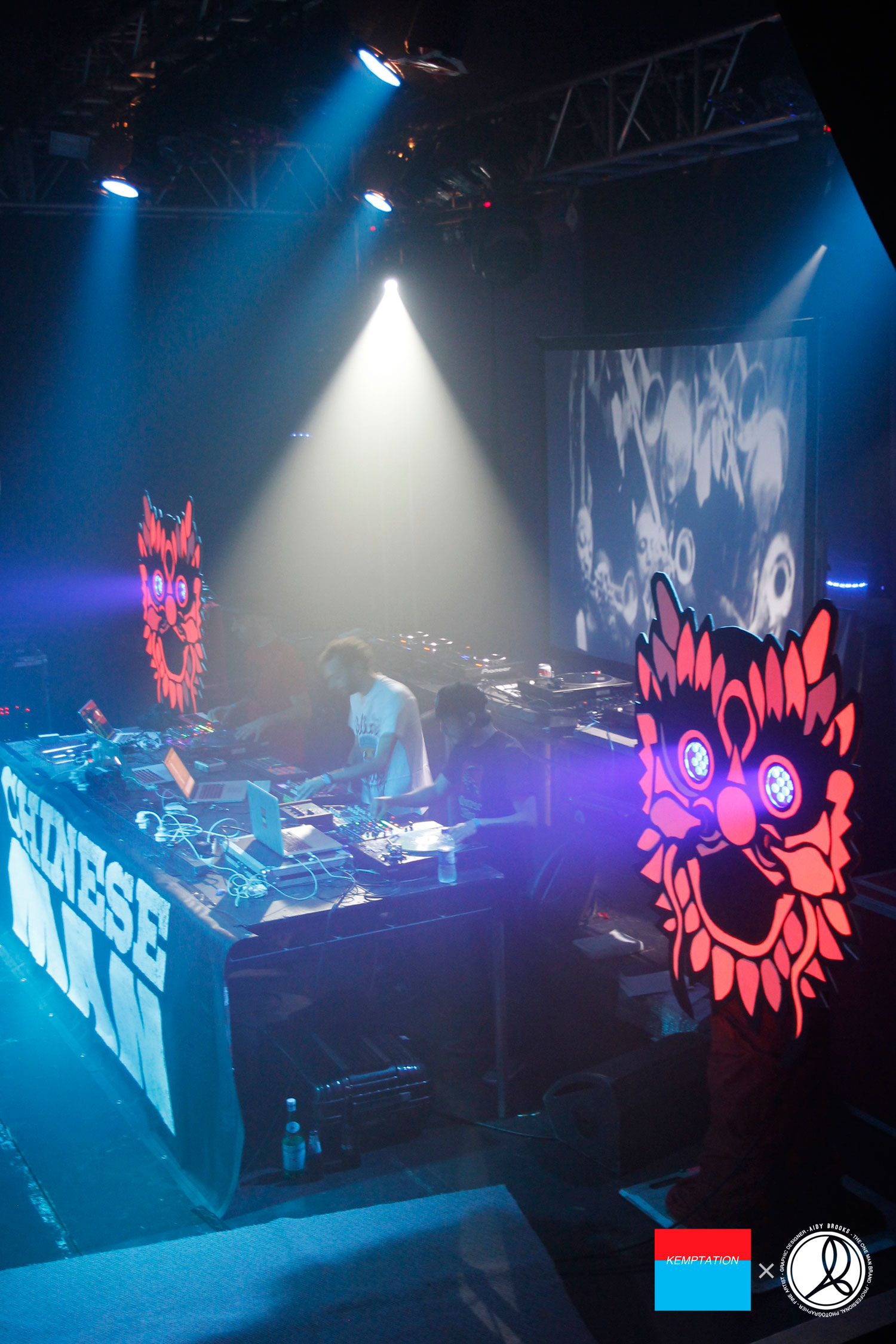
Originally published at kemptation.com on 19 May 2015. Words by Richard Kemp. Photos by Aidy Brooks

Once you get close enough, the sound of Motion, Bristol’s leading underground music venue, pulsates all around you, echoing off houses, warehouses and rushing along the grubby wet floor of each underlit street. It feels a little like you’re making your way up a hill in the dark, toward one of those old creepy hotels from a horror film, or the lair of a mad scientist. Get close enough, though, and it’s something else entirely. More like a biker den in a post-apocalyptic B-movie.

Scores of punters line the outside of the bustling club, some buying Slush Puppies, others waiting for the portaloos to open. Others still lean against the walls, drinks in hand, laying to waste any memory of a largely unmemorable working week. Inside, Motion is a labyrinth of sweaty, wet caves juxtaposed with intermittent, bright lights and throngs of people needing propping up every which way. Tonight, people are here to forget their troubles, forget their responsibilities and, most importantly, forget themselves.

French DJ troupe Chinese Man play to a sea of enlightened wanderers who, tonight, leave whoever they were at the door to jive together as one. The trio bring with them a mass of equipment and enough MCs to cover half the venue. The stage itself is flooded in light and smoke, often blinding the audience’s view, while flanking it are two dazzling pieces of artwork: totem heads made from a collage of digitised leaves. The sharp eyes of each electronic head pulsates with every pound of bass.

The smoke hadn’t really cleared by the time Chinese Man started their set, which left some people scratching their heads and wondering whether this was the group they had come to see tonight. Many simply followed their ears.

Chinese Man play to a sea of enlightened wanderers who, tonight, leave whoever they were at the door to jive together as one

Fans of Chinese Man are generally enticed by the group’s melding of cultures, influences and styles: electronic beatsmithing, hip-hop, jazz and Asian rhythms. It’s all there with Chinese Man. And so it was difficult to get that excited when they started with the dubstep. Perhaps the threepiece wanted to please the regular crowd, the ones that come to Motion every week to dance like strung-out zombies. Nevertheless, it was different to what the average Chinese Man fan thought they were coming for. The overuse of bass does have its good points, however, and certainly gave the venue reason to light up its hypnotic totem heads and send further punters into blissed-out trances. Plenty of Groove Sessions material came out, too (classics and soon-to-be classics), many with live MCing.

Such trying intrusions are minimal in their gripe, however, when you have the likes of Krafty Kuts & A-Skillz on second. Veterans of the live circuit, the duo had no qualms with giving the audience exactly what they wanted – and, indeed, what they didn’t know they wanted. When a DJ puts on Queen‘s Flash Gordon, for example, it’s pretty customary to look around and check you haven’t walked into a cheese night by mistake. There were hefty boos as Kuts & Skillz tried just this. However, before people even had time to throw their hands up in disbelief and walk out, the pair had cut the first ‘Flash’ in with a rolling bass and turned it into one of the most irresistible dance lines ever blasted through speakers that had electronic totem heads on either side. Such talent can be jaw-dropping at times. That and the duo had a plethora of dancing ladies in front of them.

Live review: Ghostpoet at Exchange, Bristol

Originally published at kemptation.com on 07 April 2015. Words by Richard Kemp

Easter Sunday evening: a night that fills Britain’s city streets with bountiful acts of merriment and debauchery. Two bank holidays in one weekend serve almost as an invitation to demonstrate the very best and worst in human behaviour, most of which have piled into Bristol’s pubs and clubs tonight, spilling out into the streets. Such strong visual displays of booze-soaked disorder seem the perfect setting for a visit from one of the country’s leading talents in rhyme-based social commentary.

Ghostpoet, a.k.a. electronic beatsmith/MC Obaro Ejimiwe, graces a sold-out Bristol Exchange to rampant cheers and applause and immediately gets stuck into new track X Marks The Spot. There might be a lot of questionable activity outside, but inside this room tonight there is nothing but love – and this is reciprocated ten-fold by the singer, whose face stays in a permanent grin for the entire occasion.

It is clear with this performance that Ejimiwe has turned a corner in his musical styling. Stark electronic glitches are replaced with straight-up guitar and bass, with long, improv-like guitar solos whipping the crowd into a dancing fever of head-bobs and body jerks. Ejimiwe’s trademark spoken-word lyricism remains a constant, nevertheless, central to the delivery of every dreamy track that propels the night along.

https://www.youtube.com/watch?v=0OmtRTqeW2s

The Exchange’s sparse lighting makes the dark, sweaty venue seem more like a cavern than a nightclub round the corner from the Bristol Evening Post building. Ejimiwe draws attention to this, calling the atmosphere “tropical,” and flashing a knowing smirk. “That was the weather report, by the way” – just in case we didn’t get it, presumably. There are smiles aplenty throughout the night, with most gig-goers simply happy to see him. Ejimiwe must feel the same way, telling the crowd, “it’s been too long, Bristol!”

Latest album Shedding Skin marks an exciting new direction for Ejimiwe ­– and likely a welcome diversion for the singer – but he gracefully accepts that fans are here to hear the old stuff, too and dives into breakout single Survive It. More boogying ensues with this, as if the dancefloor wasn’t sweaty enough, while many more choose to sing along at the MC’s encouragement.

Ejimiwe clearly loves his audience, making sure to thank everyone multiple times during the set. He gives props to his band, too, taking the time to give each member a personal introduction as they offer their own flair to the proceedings.

By the end of things, Ejimiwe is drenched in sweat himself – and rightly so, after grooving up and down the stage, air drumming and jogging along to the beat of his own music, all the while trying to get the whole venue jiving in unison. He breaks the fourth wall at the final song to point out how this is generally the time for an artist to walk off stage and be called back for an encore. Instead he continues for a few more numbers before springing off the stage into the crowd to shake hands, chat and take pictures with as many people as he possibly can.

Anyone going to the Exchange tonight in search of a reason to dislike Ghostpoet would have been sorely disappointed.

Bad Films are Better Shared: Interview with Bristol Bad Film Club Co-Founder Tim Popple

Originally published at kemptation.com on 16 December 2014. Words by Richard Kemp

“We’re about enjoying films – just in a way the creators never intended.”

Plan 9 From Outer Space, The Room, Birdemic. These films all have one thing in common: they are considered inherently, explicitly and unequivocally bad. Yet film nerds worldwide cherish these works as much as (or sometimes even more than) their ‘good’ counterparts.

The recent rise of independent film groups has allowed for lesser-known flicks to get screenings where they might otherwise have been overlooked. Groups are popping up all over, often showing movies in more offbeat locations – everywhere from public libraries to car parks.

Taking a similar approach, Bristol movie lovers Timon Singh and Tim Popple came together to start something of their own, though with an entirely different mission: to fulfil their desire, “to see bad films on the big screen.”

More than just a point-and-laugh presentation of artwork gone wrong, the Bristol Bad Film Club (fondly known as The Other BBFC) exists as a celebration of cinema’s dark underbelly. The club has already screened 16 bad films, including Troll 2, Plan 9 From Outer Space and Hercules in New York, and is about to hit number 17 with Christmas/Nazi horror flick, Elves.

Kemptation speaks to the BBFC co-founder Tim Popple about memorable moments, his favourite music from bad cinema and meeting bad film idol, Tommy Wiseau, actor, director and writer of the 2003 cult classic, The Room.

Artwork by Tiffany Farrant-Gonzalez

Do people ever ask why you watch bad films? How do you answer?

At first, yeah. There was a sense that maybe some people didn’t feel ready to embrace ‘bad cinema’. Hopefully, experience coming along to our screenings has shown them the light! Essentially what we’re about is enjoying films. We’re just enjoying them in a way the creators never intended.


What’s your most memorable bad film experience?

I’m torn between screening Masters of the Universe to over 500 people outside, in Victoria Park in the summer, and meeting my bad film idol, Mr Tommy Wiseau in February. The former was an amazing experience, sharing bad cinema with so many. The latter was possibly the most surreal moment of my life. Tommy Wiseau (creator of The Room) is larger than life; a cartoon character, a mystery – and we love him for it.


Do you ever watch bad films alone? How does it differ from watching them in groups?

We do when we trial them, or in smaller groups. Part of the bad film experience is sharing the slack-jawed disbelief at how bad the films are with other people. It’s never going to be as entertaining on your own. That’s one of the things that make the film club so successful. Bad films work better in a big group. It’s the shared experience.

Artwork by Tiffany Farrant-Gonzalez


Have you had any reaction from fans (or filmmakers), who disagree with the films you rate as ‘bad’?

When we screened Supergirl in conjunction with What the Frock, the Bristol-based all-female comedy group, people disagreed that it was bad because it was a film they remembered enjoying from their childhood. But children have fewer critical faculties! And enjoying a film doesn’t mean it can’t be bad: all the films we’ve screened or plan to screen are massively enjoyable – that’s why we screen them! Supergirl, arguably, was many people’s first experience of bad cinema.


If you could meet anyone from a bad movie, who would it be and why?

Well, we already met Tommy Wiseau, and that was pretty immense. I’d love to meet Matt Hannon, the presumed-dead-but-actually-very-alive star of Samurai Cop. Samurai Cop 2 is currently being made, and we’re very excited about seeing that: it stars former James Bond, George Lazenby!


In today’s movies, music plays a big part in the overall experience. What are some of your favourite songs or soundtracks from bad movies and why?

Against the Ninja and Friends, both by Dragon Sound, from Miami Connection, are fantastic 80s cheese.

Just Hanging Out by Damien Carter, from Birdemic, is just… I don’t even know. A paean to family values, in a club scene? It’s fantastically bizarre.

And then there’s Dare by Stan Bush. Everyone remembers it from the original Transformers movie, the one with Orson Welles voicing the villain. Yes, it’s a bad film. Yes, we all love it, Yes, the song is awesome.

Introducing… Amason

Originally published at kemptation.com on 30 October 2014. Words by Richard Kemp

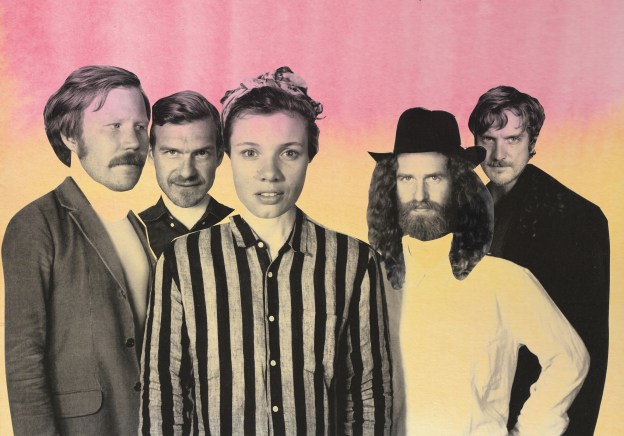
Our Introducing… series digs out new, undiscovered musical talent that deserves to be heard and delivers them directly into your ears. This round, we speak with Amanda Bergman of highly lauded Swedish quintet Amason about borrowed languages, feeding the monkeys and the band’s forthcoming debut album, Sky City.

Name: Amason

Hailing from: Stockholm, Sweden

Genre: Indie Pop

Contact: Twitter | Soundcloud | Youtube | Facebook

Upcoming shows:

31st October – UPSTAIRS, Ace Hotle, Los Angeles, USA

1st November – Origami Vinyl, Los Angeles, USA

3rd November – The Echo, Los Angeles, USA


You’ve been championed by the likes of KEXP and NPR Music as ones to watch. Has this rise in popularity been gradual? When did things really get going for you?

I do know about these radio stations and I’m sure it is a good thing if you want to spread your music around to have them play your song, so I’m very happy they did – and thankful. But as far as making assumptions about rising popularity or sinking down the drain, I have no clue. I guess it’s hard to see that kind of stuff from the inside as well for that matter. I’m sure Google has a way of measuring stuff like this nowadays, but I’m just not that interested in keeping track of numbers. I’m no good with numbers. I like making records and playing shows with people I love and I guess the ultimate sign of success would be to do shows for which people show up! To me, that’s when it gets going.


The name ‘Amason’ is taken from the Swedish spelling of the mythological female warriors. Do these warriors feature in your music at all?

Actually, I think it’s taken from a Volvo car model that everybody drove around the country in the 60s… I think it was a loose way of referring to our common wish to make some music made for car driving, or biking or fast walking.


You sing in both Swedish and English. How do you decide which language to use for each song?

I guess it comes around naturally. I couldn’t tell you exactly why one song is in English and one is not, it’s all part of the confusion. I guess some sounds seem better in Swedish and some in English. It’s all just different frequencies. And, of course, it is easier to lovingly mistreat and stretch the Swedish language since I know it so well and it’s a deeper part of one’s personality. In English, you’re always the shy guest, standing in the corner with a plate full of buffet food.


Can you tell us anything about your upcoming record, Sky City? What can we expect to hear?

It’s a bunch of songs that are all made in a very vivid process; finding the idea, mostly through a drum beat, arranging it, recording it at once and then adding the singing and the lyrics wherever it’s needed. Lots of laughter and stupid ideas, not so much thinking. Very intuitive, I guess. Therefore, the songs are quite different from one another, and I think that people will like some of them and not necessarily like others. Or they hate or love everything. I have no idea about that. I love it because I loved the process, and I like the feeling of just giving it away, almost like feeding birds or animals at the zoo. Here’s a bucket of semi-old fruit; take whatever you want and leave the rest for another hungry monkey or bird.

How would you describe your songwriting process? Do you all write together or is it more a personal thing?

It’s a very co-creative thing in our band – although, it’s mostly me or Gustav who writes the lyrics and the vocals so that’s probably where the more personal approach is added.


The fact that you all come from other great bands has led many to call you a ‘Swedish supergroup’. How is the reception for your music in your native Sweden?

To my measures it’s already all we can ask for. I think that more and more people are becoming familiar with the band, and hopefully after releasing the album next year we may have a decent chance to play some more shows in Sweden. We’re not intentionally looking to become a big act in Sweden, it’s just that you need some numbers of listeners here to be able to make a living from doing live performances, which is of course what we humbly wish for.


Each member of Amason brings his/her own influence to the band. There’s jazz in there, some surf rock, pop, synth and plenty more. Where did your sound start and where do you think it’s heading?

It all started with us five being different people, with different backgrounds both musically and personally. And then we just put it all in the blender. As I mentioned before, our debut album was put together very much with the intention of just ‘trying things out’ and ‘doing something’. I suppose a natural transformation would be to spend more time writing songs together after doing lots of live shows where we can develop our sound as a band in a natural way. I think we all agree that we want more time for the next one, and then just see what it does to the music. We don’t know more than anyone else on this matter. And that’s what I like about it.

St. Vincent at Bristol Academy

Originally published at kemptation.com on 21 August 2014. Words by Richard Kemp

Bristol Academy, UK

“I’d like to give a warm welcome to all the freaks of Bristol – you’re in good company tonight.”

It’s no wonder the entire world has fallen head-over-heels in love with St Vincent, a.k.a. baroque pop singer, songwriter, multi-instrumentalist and living, breathing surrealist art project, Annie Clark. Even before her arrival at Bristol’s Academy on Thursday night, the buzz of expectation was palpable; this was, after all, the artist who had once been a member of The Polyphonic Spree, played in Sufjan Stevens’ touring band and released an entire album of co-written material with Talking Heads frontman David Byrne. The anticipation was rife.

The lights dim, the PA crackles into life and St Vincent floats across to centre stage, her mouth fixed into a loud, infectious grin; a picture-perfect portrait of elation, she is irresistible from the off.

The band begins with Rattlesnake, the opening track from the new album, while Clark cuts Vogue-like hand movements, jerking at perfect 90-degree turns like a meticulous robot dancer. It’s a remarkably intimate show, with such close quarters that you can pick out the individual sequins on Clark’s thin, knee-length dress – black with bleeding eyes and mouths – and count the strands of curly silver hair that lollop perfectly over the left side of her face. You could have shouted something from the crowd (or even just raised your voice a little) and Clark would have heard – she might even have said something back.

Clark addresses the crowd a few times during her set, each time riffing off whatever manic-yet-delightful thought she’d brought with her that day (we all, at some point, contemplated walking into traffic, as we did burning down an entire cul-de-sac with a super-strength magnifying glass). She delivers each interlude with such confidence that you assume she’s practiced them 100 times before – and, most likely, she has. And yet, when she laughs, tiny giggles between each thought, her smile so wide like a Cheshire cat grin, you begin to wonder whether she’s come up with this on the spot. Whether she recites these lines to every audience, however, is irrelevant as it’s the delivery that makes these words soar. The penny drops and a halo encircles her shimmering head: we might just be in the company of genius tonight.

Clark grabs her guitar and begins to wail like an angel, throwing out cyborg dance moves and alien sequences with the greatest of ease, all the while hitting every single note on guitar. She shuffles along the stage to Digital Witness, her gaze fixed on every single audience member – such immersive eyes that follow you around the room – torso barely moving, as if being towed along on an airport’s flat, moving walkway. Part mannequin, part Stepford Wife, the multi-coloured lights project her as Jekyll and Hyde, though you feel safe in the hands of either one.

St Vincent is not just someone who can perform the hell out of any other artist working today: she nurtures her audience, calmly encouraging everyone to get involved, to start dancing and unleash the freak within. Some of us work harder than others to keep the inner freak contained and St Vincent shows us just how fulfilling life can be if we let our freakiness come out to play.

The stage backdrop is a long velvet curtain with a giant, pastel pink podium in front, which Clark climbs to perform numbers Prince Jonny and Cheerleader. Up top, guitar strapped to her shoulders, the spotlight focuses on Clark, who looks now like she’s set to star in a Broadway musical – perhaps this show would have been better placed at the Hippodrome theatre. This mystique is quickly broken, however, as Clark’s vocals on Cheerleader are swapped for a deep, bottomless, satanic growl that chills the spine and makes you want to shiver until all your bones have separated and fallen to the floor in a deathly clatter.

The rest of the band, while naturally overshadowed by St Vincent’s god-like presence, manage to shine through, too. Drummer Matt Johnson does a solid job of keeping up with every chop and change, while DJ Daniel Mintseris manages to escape his laptop every now and then to throw out a groove of his own. Toko Yasuda carries the ship on bass and Moog, taking care of business whenever Clark’s synchronised dance moves require less guitar work, even joining in for a few steps.

The band finishes and walks off stage, a job well done. The lights aren’t coming on, though, and everyone knows there’s an encore on the way. Even still, the entire venue fills with whoops, hollers, screams, wails and stomps of feet, calling for St Vincent’s imminent return. Clark comes back and climbs the pink podium once more to blast out a jaw-dropping rendition of Strange Mercy while her shadow plays on the velvet curtain behind, distorting her form into that of a Mexican revolutionary holding a bayonet. The crowd is floored in awe; if a flying saucer had beamed down at that moment, with Clark announcing it time for us to leave with her for the new world, not a soul would have argued.

Back on Earth, Clark finishes her set in splendid fashion: perched on the shoulders of a local security official. It looks, for a moment, like she’s about to leap into the crowd, but instead she offers her guitar out to audience members who dutifully hack away at the six strings, Clark throwing her head back, cackling like a maniacal witch. She clambers back on stage and hands her guitar to a roadie, seeming to say, “You play, don’t you? Well, go on, then!” The roadie, unsure whether she really meant it, simply stands there, motionless and painfully awkward – a little, lost lamb in the middle of a rock ‘n’ roll gig – but Clark has moved on, tipping an entire bottle of water out on stage and then proceeding to conduct Johnson’s drum lines. A good minute of flailing arms, Yusuda and Mintseris holding it all together, and then Clark kneels at centre stage, beckoning the roadie to return with her guitar. He lays the strap over her head, like a crown of thorns, and then disappears, Clark left to writhe upon the water-soaked floor.

The end arrives and there is an exhaustion in the air – from the floor as much as the stage – as the people of Bristol begin to process what they have just witnessed; the kind of gig you only see once in a lifetime. The band stands tall as Clark takes a bow and the emotion rises; it’s all anyone can do not to conjure a fresh bouquet of flowers out of thin air and throw them at her feet.

People left Bristol Academy that night with a new idea of what a ‘performer’ can be, the bar undeniably raised to that of St Vincent. She sings. She dances. She plays guitar. Not even Fred Astaire could do all three.

If, in fact, the whole world is not yet in love with St Vincent, they certainly should be. She is, without doubt, one of the greatest performers of our generation. A must-see for anyone who has ever dreamt of getting lost in space.

10/10