Live review: Chinese Man at Motion, Bristol

Originally published at kemptation.com on 19 May 2015. Words by Richard Kemp. Photos by Aidy Brooks

Once you get close enough, the sound of Motion, Bristol’s leading underground music venue, pulsates all around you, echoing off houses, warehouses and rushing along the grubby wet floor of each underlit street. It feels a little like you’re making your way up a hill in the dark, toward one of those old creepy hotels from a horror film, or the lair of a mad scientist. Get close enough, though, and it’s something else entirely. More like a biker den in a post-apocalyptic B-movie.

Scores of punters line the outside of the bustling club, some buying Slush Puppies, others waiting for the portaloos to open. Others still lean against the walls, drinks in hand, laying to waste any memory of a largely unmemorable working week. Inside, Motion is a labyrinth of sweaty, wet caves juxtaposed with intermittent, bright lights and throngs of people needing propping up every which way. Tonight, people are here to forget their troubles, forget their responsibilities and, most importantly, forget themselves.

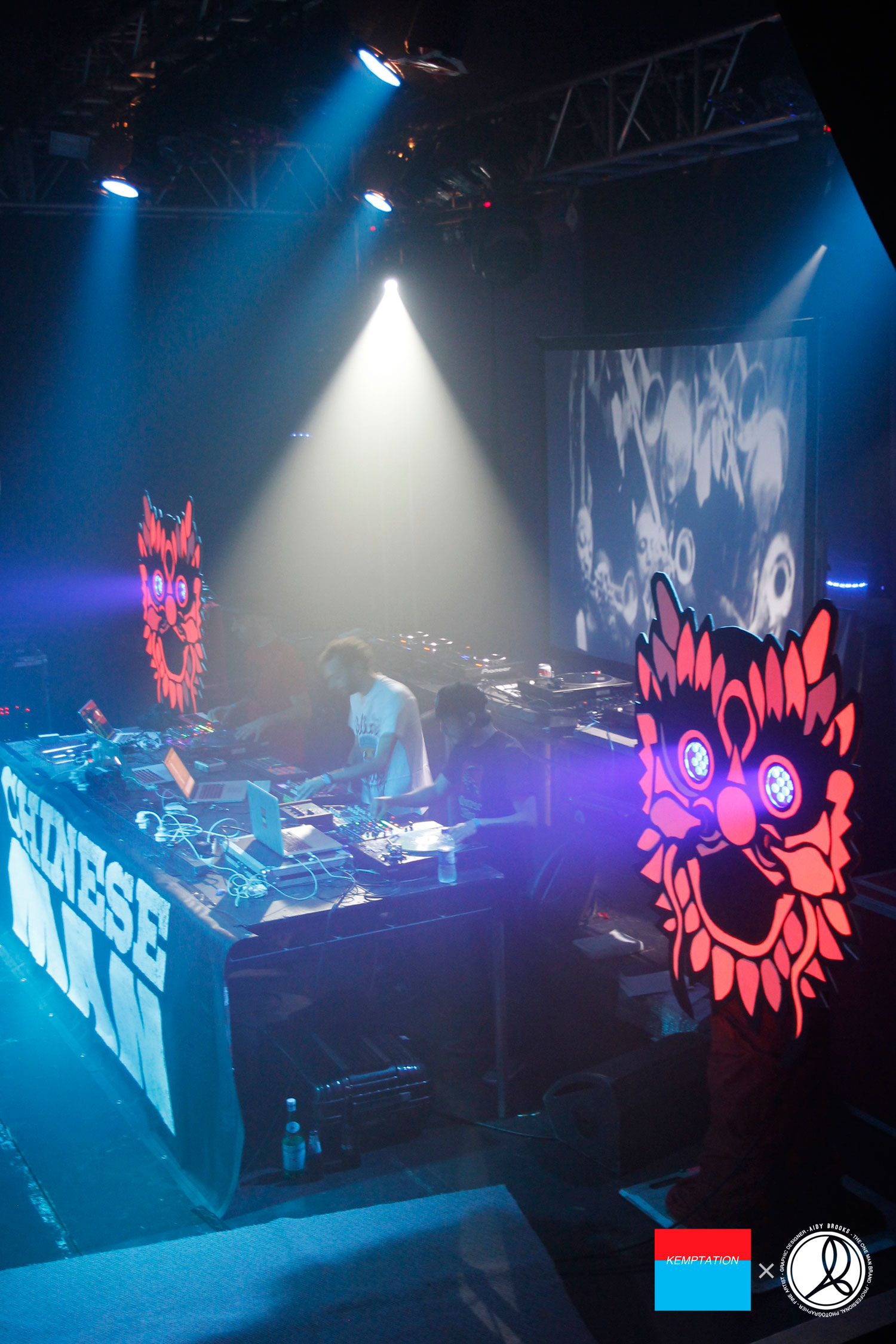
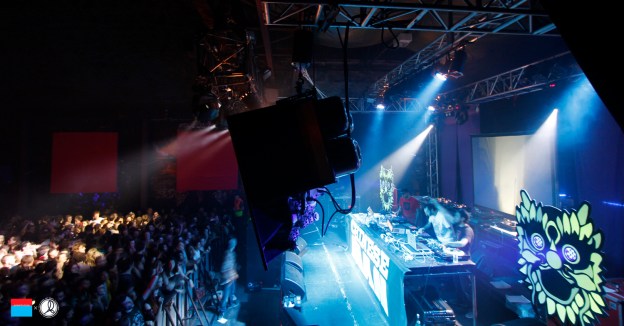
French DJ troupe Chinese Man play to a sea of enlightened wanderers who, tonight, leave whoever they were at the door to jive together as one. The trio bring with them a mass of equipment and enough MCs to cover half the venue. The stage itself is flooded in light and smoke, often blinding the audience’s view, while flanking it are two dazzling pieces of artwork: totem heads made from a collage of digitised leaves. The sharp eyes of each electronic head pulsates with every pound of bass.

The smoke hadn’t really cleared by the time Chinese Man started their set, which left some people scratching their heads and wondering whether this was the group they had come to see tonight. Many simply followed their ears.

Chinese Man play to a sea of enlightened wanderers who, tonight, leave whoever they were at the door to jive together as one

Fans of Chinese Man are generally enticed by the group’s melding of cultures, influences and styles: electronic beatsmithing, hip-hop, jazz and Asian rhythms. It’s all there with Chinese Man. And so it was difficult to get that excited when they started with the dubstep. Perhaps the threepiece wanted to please the regular crowd, the ones that come to Motion every week to dance like strung-out zombies. Nevertheless, it was different to what the average Chinese Man fan thought they were coming for. The overuse of bass does have its good points, however, and certainly gave the venue reason to light up its hypnotic totem heads and send further punters into blissed-out trances. Plenty of Groove Sessions material came out, too (classics and soon-to-be classics), many with live MCing.

Such trying intrusions are minimal in their gripe, however, when you have the likes of Krafty Kuts & A-Skillz on second. Veterans of the live circuit, the duo had no qualms with giving the audience exactly what they wanted – and, indeed, what they didn’t know they wanted. When a DJ puts on Queen‘s Flash Gordon, for example, it’s pretty customary to look around and check you haven’t walked into a cheese night by mistake. There were hefty boos as Kuts & Skillz tried just this. However, before people even had time to throw their hands up in disbelief and walk out, the pair had cut the first ‘Flash’ in with a rolling bass and turned it into one of the most irresistible dance lines ever blasted through speakers that had electronic totem heads on either side. Such talent can be jaw-dropping at times. That and the duo had a plethora of dancing ladies in front of them.

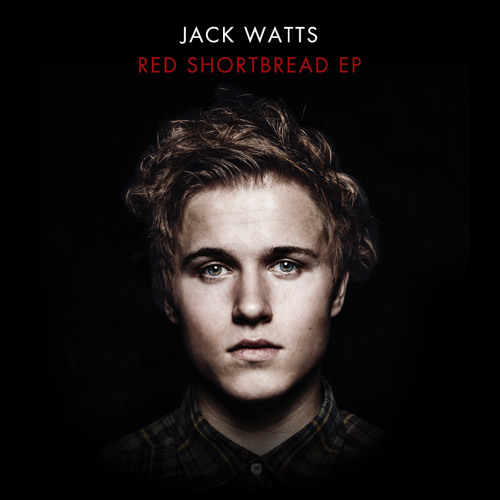
Jack Watts – Red Shortbread EP

Originally published at kemptation.com on 17 May 2015. Words by Stephanie Yip

Released 17 May 2015 via BARP Records

20-year-old Brighton lad, Jack Watts is the kind of up-and-coming artist that will floor you the instant his ethereal vox hit your eardrums. Though notably inspired by Jeff Buckley and Radiohead, his sound rather lends itself more toward the acoustic and jazzy sides of Ben Howard, Nina Simone, Justin Nozuka and Damien Rice as beautifully raw and emotionally intense lyrics are stripped from his throat in a hushed melody of brilliance.

His debut EP Red Shortbread might be short, consisting of a mere five tracks (one of which is a cover), but all four originals come delicately crafted and even more delicately executed. And as each song unravels, it becomes disturbingly clear that Watts either has a talent for tearing at our emotions inch by inch, or tearing himself apart inch by inch.

Opener, We Lost It All, rings heavily of motown funk, introducing itself with a series of gentle guitar pluckings and a rasp of vocals before breathing life into a tale of loss and despair.

Push Blue follows. It’s the second single off the EP and a more memorable track to be fair. Still soft in its demeanour, it peaks at just the right moment, writhing in the silent anger that is felt when a relationship goes sour. Its intensity is only heightened when viewing Watts perform the song: the conviction in his face twisting the knife even farther, ever slower.

Title track Red Shortbread rests comfortably in the meaty middle of the EP. Lilting falsetto is ready for redemption as a torn, broken and otherwise vulnerable Watts screams to his love for salvation and aid singing: “Sort me out/ ‘Cos I’ve been broken for too long now/ And I need you more than ever/ I need you tonight.”

In an intriguing chance of pace, Watts uses his EP’s fourth spot to cover Sinatra’s It Was A Very Good Year. His is a jazzy, down tempo rendition that you could imagine being sung in a smokey underground bar full of guys and dolls. Though captivating and sultry, oddly enough it doesn’t quite sit too well in this collection. Lacking Watts’ husky tones, it’s execution is more sentimental than sad and never quite hits the heart in a record otherwise saturated in emotion.

All is forgiven however with Watts’ final song. Named One Last Kiss, it’s again a change of pace, that comes complete with an up tempo beat, electric guitar and rock edge. But what sets it apart from its predecessor is that it utilises those stunning rasped vocals that we’ve grown so familiar with these past 20 or so minutes, making it feel just right. Couple that with a glowing sense of conviction as Watts begs for “one last kiss” before saying goodbye and the EP is complete.

It’s goodbye for now, but doubtfully not forever. Because if this is the kind of emotional rollercoaster a 20 year old Jack Watts can deliver in just four songs, one can only imagine what’s in store for us when he’s ready to deliver a full-length album.

Plain White T’s – American Nights

Originally published at kemptation.com on 14 April 2015. Words by Stephanie Yip

Released 28 April 2015 via Megaforce Records

There are bands that constantly evolve, altering their sound, content and get-up in line with what’s currently being digested on the charts. Then, there are bands that you can constantly bank on to remain exactly how you remembered them when you first laid your ears to their music so many years ago.

Plain White T’s is one of the latter.

After what seems like a lifetime of hiatus (their last record, Wonders of the Younger was released in 2010 before they entered a so-called ‘career limbo’) the five-piece pop-rock band has returned with their latest full-length, American Nights. And in case longtime fans are wondering, yes, it IS everything you remember the Plain White T’s to be: Poppy, energetic, romantically inclined and all-round fun. And as for the get-up? There’s nothing new here either, with all five original band members (from 2002 onward) returning for your listening pleasure.

The record opens with title track, American Nights. It’s a poppy love song that doesn’t take itself too seriously and does well to lift the spirits and the lungs, howling woooaaahhhh into the star-filled sky right unto the very last. It’s a lead-up into something slightly more down tempo, but no less easy-on-the-ears.Bred from happy-fantastic land of feel-good ditties, Pause sings of slowing down, looking around, and appreciating what’s around you.

Never Working is probably one of the least memorable tracks on the record. There’s always one, I guess. It’s quite moot, a little repetitive and seems not to actually go anywhere (guess that’s why it’s not working?). On the plus side, it’s a short-lived number and is followed by a more fun and digestible one called Heavy Rotation. Welcome something flirtatious and cute. And, in true Plain White T’s style, is not-so-secretly also an ode to a girl that singer Tim Lopez is puppy-dogging over. And while it pales in comparison to the band’s breakout and biggest hit, Hey There, Delilah, it’s still very much a contender for an upcoming single.

The halfway point brings on the slower ballads – another area where the Plain White T’s shine, and they do so grandly with Stay. Calling out to that girl, it pulls on all the emotions of the predominantly female fan base, with vocalist Tom Higgenson calling out for one more chance with the love he’s losing. Finally, there’s the standout ballad, You Belong. Again, it’s another love song that finds Higgenson serenading that perfect halo of a woman, placing her on the pedestal of a goddess. Listening to it, it almost feels as though you’ve entered a reverse Taylor Swift music universe, where all that rings across the airwaves is divine worship, as opposed to hateful revenge.

And just like that, the Plain White T’s crank up the energy again for a rollicking, fist-pumping medley of daydreams and romance, the kind that you can imagine spinning around in circles to until you’re dizzily flopping onto the floor, smile permanently fixated upon your childish little mug.

While plain in tone and harmony, the saving grace for Someday You’re Gonna Love Me is in the lyrics. Inevitably, among the poppy haze and four-beat melody, what Plain White T’s has got down to a, well, you know… (T), is their ability to reach out to the ladies and make them fall in love with them. With words. With romance. With a Mr Darcy kind of ultimate perfection. There’s this unmistakable air of euphoria that their lyrics, rife with conviction, induce that send women into an unbearable ovulating swoon. And the song’s sugar sweet somethings: “When we see things clearly / You’ll know I’ve loved you all this time / And I promise every kiss will be the sweetest of your life” might just send you there.

Love Song is another fine example of exactly what Plain White T’s does, only this time round, it’s a different kind of europhia – more giddy, less sentimental. Like sunshine on a rainy day, it’s the kind of ditty that lives in a tropical holiday or a 1980s video clip, where backup dancers sway and clap in tune with the music, smiles plastered onto their faces and Hawaiian shirts swaying gently in the breeze. It’s cheesy but oh-so-ridiculously fun.

Penultimate track, Time to Move On brings us back to the land of traditional pop, taking a page from Pause, it’s another lighthearted, positive song about looking forward, head-high and future bright and runs gleefully into the arms of the album’s closer: Here Comes That Sunrise. As expected, it’s another positive song about looking forward, head-high and future bright (repetition intended) with just a little more ‘oomph’ than its predecessor to really close off the record.

While nothing new, nothing progressive, and nothing compared to the success of Hey There, Delilah, Plain White T’s are everything you remembered them to be.

Welcome to nostalgia. Glorious, euphoric, pop-rock nostalgia.

Live review: Ghostpoet at Exchange, Bristol

Originally published at kemptation.com on 07 April 2015. Words by Richard Kemp

Easter Sunday evening: a night that fills Britain’s city streets with bountiful acts of merriment and debauchery. Two bank holidays in one weekend serve almost as an invitation to demonstrate the very best and worst in human behaviour, most of which have piled into Bristol’s pubs and clubs tonight, spilling out into the streets. Such strong visual displays of booze-soaked disorder seem the perfect setting for a visit from one of the country’s leading talents in rhyme-based social commentary.

Ghostpoet, a.k.a. electronic beatsmith/MC Obaro Ejimiwe, graces a sold-out Bristol Exchange to rampant cheers and applause and immediately gets stuck into new track X Marks The Spot. There might be a lot of questionable activity outside, but inside this room tonight there is nothing but love – and this is reciprocated ten-fold by the singer, whose face stays in a permanent grin for the entire occasion.

It is clear with this performance that Ejimiwe has turned a corner in his musical styling. Stark electronic glitches are replaced with straight-up guitar and bass, with long, improv-like guitar solos whipping the crowd into a dancing fever of head-bobs and body jerks. Ejimiwe’s trademark spoken-word lyricism remains a constant, nevertheless, central to the delivery of every dreamy track that propels the night along.

https://www.youtube.com/watch?v=0OmtRTqeW2s

The Exchange’s sparse lighting makes the dark, sweaty venue seem more like a cavern than a nightclub round the corner from the Bristol Evening Post building. Ejimiwe draws attention to this, calling the atmosphere “tropical,” and flashing a knowing smirk. “That was the weather report, by the way” – just in case we didn’t get it, presumably. There are smiles aplenty throughout the night, with most gig-goers simply happy to see him. Ejimiwe must feel the same way, telling the crowd, “it’s been too long, Bristol!”

Latest album Shedding Skin marks an exciting new direction for Ejimiwe ­– and likely a welcome diversion for the singer – but he gracefully accepts that fans are here to hear the old stuff, too and dives into breakout single Survive It. More boogying ensues with this, as if the dancefloor wasn’t sweaty enough, while many more choose to sing along at the MC’s encouragement.

Ejimiwe clearly loves his audience, making sure to thank everyone multiple times during the set. He gives props to his band, too, taking the time to give each member a personal introduction as they offer their own flair to the proceedings.

By the end of things, Ejimiwe is drenched in sweat himself – and rightly so, after grooving up and down the stage, air drumming and jogging along to the beat of his own music, all the while trying to get the whole venue jiving in unison. He breaks the fourth wall at the final song to point out how this is generally the time for an artist to walk off stage and be called back for an encore. Instead he continues for a few more numbers before springing off the stage into the crowd to shake hands, chat and take pictures with as many people as he possibly can.

Anyone going to the Exchange tonight in search of a reason to dislike Ghostpoet would have been sorely disappointed.

Interview: Laibach

Originally published at kemptation.com on 17 March 2015. Words by Andrejka Zupancic

Laibach are one of very few acts truly deserving of the cliché, ‘more than just a band’. Formed in 1980, in the rural town of Trbovlje, Slovenia, Laibach became the musical arm of the Neue Slowenische Kunst (New Slovenian Art) collective, a group so radical that it would go on to found its own country, even issuing passports and opening embassies.

Laibach have influenced many great acts across multiple genres. According to Trent Reznor, if there had been no Laibach, it would be hard to ever imagine Nine Inch Nails or Rammstein coming into being.

Laibach, relevant as ever (or perhaps even more so), are currently haunting Europe with their eighth studio album, Spectre. We speak with the band about the new album, its message, the future of Europe and the concept of their international Party (you can’t leave the Party, apparently, but the Party can leave you).


You are currently on tour, promoting your album, Spectre. The lyrics have quite a political tone. What is the message of the album?

Spectre is basically a kind of ‘manifesto’ of the international Party, which we founded at the launch of the new album. There is an increased engagement in consciousness in Europe and elsewhere in the world – people are tired of the existing political and economic order and want to take power into their own hands and return the dignity and solidarity to social relations in ordinary life. In doing so, we can only support them and, in addition, we simultaneously try to return some political relevance and dignity into popular culture.

The entertainment industry should be fun (in the first place, at least), but it should also take its fair share of responsibility for the common social and political climate. Most of the popular entertainment industry today is completely trivialised and lost on all levels, particularly in the context of the basic issues of social justice and politics. One of the reasons for the establishment of a party is, therefore, also self-destructive; a cynical status in popular culture. Today, nobody takes music seriously, musicians and the music industry have gambled it away. But we believe that music can, in principle, still work as a mobilising force – think of all the brilliant periods in the history of pop culture – if it is not encumbered with itself, if it does not behave only as ‘music’, if it exits from its media and operates in the so-called ‘underground’, if it anarch-organises itself – not as a sub-culture alternative, but as a whip of God. Spectre therefore deals with this kind of content.

What is the purpose of the Party?

We established the Party as the classic ‘Stalinist’ international Party. It is available to all those who may be inspired by Laibach and who want something more than to just blindly consume ideas and objects. We do not want it to be a fan club; rather, we want socially and politically sensitive members who will actually engage themselves in their environments and connect and support one another (and help with other related projects), even remotely. We will also direct them a bit, so as not to get too mired in strange waters, but we will still allow them enough freedom, or at least its illusion.


You all have pseudonyms: Dachauer, Keller, Saliger and Eber. What do they mean?

Laibach works as a team, with a collective spirit, following the model of industrial production and totalitarianism. This means: no individual speaks; the organisation speaks.

The entertainment industry should take its fair share of responsibility for the common social and political climate.

Our work is industrial, language is political. The internal structure works on a directive principle and symbolises the relationship of ideology to an individual. The members of Laibach, since 1982, are Eber, Saliger, Dachauer and Keller, making a quadruple principle which, predestined, conceals any number of sub-objects (depending on needs). The flexibility and anonymity of membership prevents eventual individual deviations and allows a permanent revitalisation of the inner life juices. Subject, which can in the process of work be identified with extreme position of contemporary post-industrial production, automatically becomes a member of Laibach. Others hold the status of colleague.

Where are most of your concerts taking place and do you have a favourite audience?

We do not discriminate between audiences – or, at least, we pretend not to. We are politically correct enough that we are willing to lie about this. Nevertheless, our favourite audience is one that most loves us or hates us; those are the ones that are most inspirational.

The group was founded in Trbovlje. Do you still come back and organise concerts in your hometown?

Yes, we do that on a regular basis, in part because we were banned in Trbovlje when the band formed in 1980. It was in 1990 that we finally performed there for the first time – and even then under the watchful eye of the police. But Trbovlje gave a sense of perseverance, humour, ruggedness and sophistication. It marked us, so completely and thoroughly, that we still return to this, the most beautifully ugly city in the world.

It wasn’t until 1990 that we were finally allowed to perform in Trbovlje – and even then it was under the watchful eye of the police.

This is a typical Slovenian trait of dark cynicism and scepticism, but people in Trbovlje, though they are subject to all the junk of social roughness, are actually very sensitive and good. Today, the city varies considerably and instead of mining, power plants and heavy industry, there are now sophisticated companies such as the software company Dewesoft, which makes software for NASA in the USA and similar. A new youth culture has emerged, too, which organises the radical sound and music festivals. A new avant-garde collective has also formed, which hosts an annual international festival of new media called Speculum Artium – a few days of the year in which Trbovlje transforms into Slovenian Ars Electronica. Guests, artists, scientists and theorists come from all over the world – and we, of course, imagine that this change happened partly thanks to Laibach.


In your song, Eurovision, you proclaim ‘the collapse of Europe.’ Do you have a vision of how much time Europe has left?

Europe, as we know it and want it to be, does not exist. It is just a fiction, a desire, an illusion. The Europe that really exists is an intertwined and interdependent system in constant disintegration. And it seems this disintegration is the only stable principle through which Europe de facto has always been established. This was the case in the past and this will probably be the future. We wish her a safe journey and hope someday Europe will span the territory from the Atlantic to the Pacific.

After the release of your new album you are again getting politically active. In the 80s, the British press described you as “the most dangerous band in the world”. Why?

We do not know why. It probably seemed inconceivable to them that there could be such a radically different interpretation of the world, so different from the vision offered by the British and Anglo-American pop-rock sentiment.


What are the similarities and differences between Spectre and NSK (New Slovenian Art)?

The NSK was established at its inception and defined as an ‘abstract organism, supremacist body installed in a real political space as a social sculpture, consisting of the body heat, spirit and movement work of its members’. It is open to all, without exception, who want to become its citizens. Therefore, we left the country to its citizens, to organise themselves in any way they know how.

Unfortunately, nothing significantly different came out of it than just a kind of Laibach-ish. The NSK fan club was all about being some kind of artistic installation and trying to be to be more papal than the Pope. Therefore, we decided to establish a Party that would require from its members a specific social and political engagement and, therefore, give them specific tasks. Party membership is open to anyone to whom Laibach can serve as an inspiration and a formal link with like-minded subjects around the world – and we ourselves will be the ones conducting the Party.


In all your years of existence, who has tried to censor you most?

Ourselves. If this was not the case, today we probably would no longer exist.


What are your plans for the next album?

It exists, and we will start getting more involved with it, intensively so, in the second half of the year. But, for now, it is still too early to talk about it.


SPECTRE DIGITAL DELUXE ALBUM & SPECTREMIX OUT 30 MARCH 2015

UK Tour Dates:

30 March – Brighton, Concorde 2
31 March – Glasgow, Classic Grand
2 April – London, Electric Ballroom
3 April – Manchester, Academy 2

Inspirational Study Music

Whether you are studying for an exam, working through piles of research or just looking for a calm spot to read a book, music can make all the difference.

The right record at the right time can take your creativity levels from good to spectacular. You can’t just listen to anything, though – in fact, different sounds bring about different results.

Whatever you’re studying for (school, university, art college or night school), you need a soundtrack that works. And that’s what we’ve tried to make with this latest mix.

So put the kettle on, find a comfy chair and lose yourself in some inspirational study music.

Track breakdown

http://quietus_production.s3.amazonaws.com/images/articles/8659/glass_1335639714_crop_550x550.jpg

Philip Glass – Glassworks

It’s meditative and hypnotic, almost dream-like, and also really uplifting – something I need in times of hard study. MG


Lusine ICL – Language Barrier

Largely beatless album of gently-pulsing electronica which comprises washes of synth, some treated, looped guitar and twinkly bits while managing to sound simultaneously melancholy and euphoric. A warm bath of a record that grows with every listen. JC


Faures – Continental Drift

Imagine being being cast adrift in space, like the scene at the start of Gravity. Except instead of panicking, like Sandra Bullock does, you are deeply relaxed and witnessing something cool like the birth of a star, from a safe distance. That’s what this album sounds like. Nothing much happens, but then space is like that, I guess. JC


Explosions in the Sky – Those Who Tell The Truth Shall Die, Those Who Tell The Truth Shall Live Forever

A regular pick in most study lists, but for very good reason. Listening to Explosions… is like transcendence for the ears. RK


http://s3.amazonaws.com/typerecords_site/covers/255/type055_cover_med_medium.jpg

Richard Skelton – Landings

A good remedy for overworked brains! 

MG


Mountains – Centralia

Mountains‘ third album combines live instrumentation with vast walls of drone-like electronic noise. When I am trying to plan a lesson in a staff room full of chattering teachers this is the album I listen to. The record has a certain post-rock sensibility, demonstrated during the 20-minute long Propeller, which slowly builds to a crescendo of noise, before climbing back down again. Awe-inspiring stuff. JC


Susumu Yokota – Sakura

Japanese producer Yokota‘s early 90s ambient masterpiece combines loops of live instrumentation with vocal chants and lush synth work. Sakura is minimal, hypnotic and calming, and seems so much more than the sum of its parts. This is your best bet if you really need to concentrate. JC


A Winged Victory for The Sullen – ATMOS

Written to accompany a dance performance. I guess you would call this modern classical music. ATMOS is pretty serious stuff, but it’s also beautifully realised and profoundly moving in parts. JC


The Cinematic Orchestra and London Metropolitan Orchestra – The Crimson Wing OST

The only Disney soundtrack you need in your life. The Cinematic scores a nature documentary about pink flamingos, and the result is a rich, emotional, tour de forceJC


Jon Hopkins – Asleep Versions

Hopkins here produces stripped back, lush, ambient versions of four tracks lifted from 2013’s ImmunityJC


Global Communication – 76.14

One of my favourite albums of all time and, in my my mind, the best electronic ambient record ever made. Also doubles up as a perfect ‘sleep’ album if you want to take a nap on a train/plane/bus. JC


Portico Quartet – Isla

These Bristol musicians create a mesmerising mix of jazz and ambient sounds on this, their debut album. The group get bonus points for featuring criminally underused instrument, the ‘hang’. Some of the tracks include pretty crazy improv solos, so perhaps better suited to accompany creative work – abstract painters would love it.


Poppy Ackroyd – Escapement

London-born musician and composer Poppy Ackroyd coaxes beautiful noises from her piano in an unusual way; plucking or scraping the dampers and strings inside, or even taping the frame. She then records violin and multi-tracks the individual sounds together on her laptop. The result is delicate, ethereal, complex, and surprisingly accessible.