Originally published at kemptation.com on 12 April 2016. Words by Andrejka Zupancic
Slovenia’s industrial avant-garde pioneers Laibach first spoke to Kemptation writer Andrejka Zupancic in March 2015. In the interview, a feature which benefits from multiple readings, the band appeared to cover every angle, unafraid to speak their political minds and making reference to police surveillance, manifestos and the illusion of Europe, an institution that was born into a state of “constant disintegration”.
Since this first interview, the Eurozone has taken a giant hit, Greece’s finances have imploded, mass migration has swept the continent and politicians have had their dirty laundry exposed via the infamous Panama Papers.
The band travelled to North Korea in 2015 to play their first set of concerts there, and the first by a Western artist. Indeed, if Laibach were relevant before, they are more so now than ever.
Andrejka Zupancic speaks to the band in the run-up to their appearance at London’s O2 Forum Kentish Town.
You recently played live in North Korea. How was that – and was there ever a moment where you feared you may not return?
The journey to North Korea was very casual. There were no complications; perhaps most of us were a little afraid that we would feel too good and we would be more scared of returning home.
Did you adapt your repertoire of songs to the Korean audience?
North Korean cultural censorship is much more innocent and ethical compared to censorship that is happening in developed countries, where there is dictatorship of the market and capital
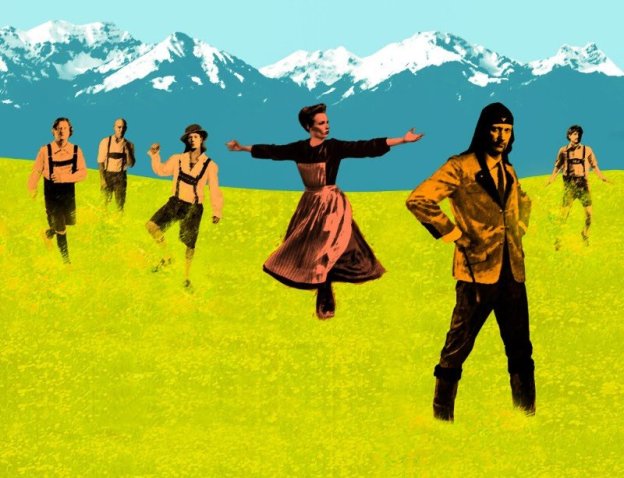
Although as a rule we do not discriminate against our audiences, in the case of North Korea we decided that the program would communicate along the perceptions of the Korean audience, which, in both the aesthetic and value senses, functions in a completely different paradigm to Western and European audiences. We therefore chose songs that were, at least to some extent, known to them. Tunes from the musical The Sound of Music, for example, are relatively well known because they learn English through these songs in high school. They even have their own arrangements of songs from this film – of course renovated following the model of their cultural milieu. In the processing of the Western samples, North Koreans use a similar method to what we use in Laibach and, therefore, we felt it would be appropriate to offer them their own version of songs from this famous musical, to show the parallels between “them” and “us”. Part of the audience had heard at least of The Beatles and so we played our version of Across the Universe. We also added a few cover versions of their popular songs, specifically We’ll Go to Mount Paektu, Honourable, Alive or Dead, Arirang and some stuff from our iron repertoire (Final Coundown, Life is Life, etc.), which to some extent also has a “heroic” character.
Was there censorship present?
Of course – as we expected, though it did not burden us. North Korean cultural censorship is much more innocent and ethical compared to censorship that is happening in developed countries, where there is dictatorship of the market and capital. They asked us to withdraw some of the songs, because they were simply too aggressive in their view, and this was done without any problem. The concert was no less “subversive”, though. In a way, it is simply impossible to censor Laibach; then it would no longer be Laibach.
How long have you been cooperating with Norwegian director Morten Traavik and how did this cooperation develop?
We met Morten as a director and multifunctional artist two years ago and we immediately offered him the job of directing the video for song Whistleblowers, from the last album Spectre. He was the one who suggested we all go to Pyongyang and perform two concerts in the North Korean capital. Through his projects, Morten has been successfully opening the door to North Korea for a long time. He also managed to convince us that Laibach was right for them and so a tour followed. Arrangements for the tour took almost an entire year – until the last minute, we were not even sure whether the performances in Korea would really happen.
How did the audience react to the performance?
Although most North Koreans have never heard such music as that played by Laibach, the audience reacted well, applauding for each song and giving a standing ovation at the end of the concert. Choe Jong Hwan, an older visitor, gave the following statement: “I did not know that in the world there is such music, but now I know.”
How the world will develop in the future really does depend on which direction the EU goes
Rodong Sinmun of the Workers’ Gazette (business newspaper of the Central Committee of the Workers’ Party of Korea) wrote the next day on the cover: “Artists with strong voices presented a very peculiar singing style and highlighted the beauty of each song with their virtuosity and, in this way, showed the artistic format of the group. And, much to the joy of the audience, Laibach played an extremely good version of the Korean song Arirang.”
Do you think that you have left a significant impression with your appearance and will your performance in any way affect the long-term change in Korean music and its art scene?
We certainly left behind some impression in North Korea – and elsewhere in the world probably even more so, which to this country and its culture, as a rule, behaves with derision and contempt.
In your song Now You Will Pay, you sing that “barbarians are coming, crawling from the East.” Can that somehow be interpreted as a prophetic forecast of what is happening in Europe today?
Given the fact that the song was originally recorded 13 years ago, in the perspective of the current refugee exodus, it really is very prophetic. Although, at the time of its creation, it referred more to the Eastern European nations that had joined the EU back then.
How much time remains for Europe as we know it today?
Europe, as we know it (and wish it to be) is essentially non-existent. It is a fiction, a desire, a mirage, a utopia. The real Europe is a system in constant disintegration. That disintegration is essentially the only stable principle on which Europe is de facto formed. With each decay of Europe – seen from an historical perspective – it is paradoxically, increasingly, becoming more stable. Therefore, despite all logic, we believe in a united Europe (which preferably would be all the way to Tokyo), as we have always believed in utopias and we hope that the idea of such a Europe could be realised. But this should not be cold Europe, led by political technocracies from Brussels or Frankfurt banking sectors and operated according to the dictates of neoliberal dogma. Instead, it should be the community, based on a common emancipatory project. And maybe the current disintegration of Europe, together with the current refugee-emigrant issues, should be taken very seriously to reverse the direction of Europe’s vision towards positivity.
How do you see the global organisation of the world in the coming years or decades? Do you think there will be enormous changes?
In light of the global organisation of the future world, there are three or four possible scenarios. After the first world, there will be domination and competition with one another – in the military, economic and cultural fields and in values – between several poles, such as the US, China, Russia, Europe and perhaps even any other pole. This is essentially already happening. Relationships will (continue to) run mainly (in selfish equity) in the interests of the individual poles.
The second utopian scenario shows the world in increased cooperation, domination of the idea of the United Nations and stable cooperation. There would be a kind of modern “Global Alliance” of nations. Hopefully, that could become true, although there is very slim possibility.
Europe is a fiction, a desire, a mirage, a utopia. The real Europe is a system in constant disintegration
The third scenario shows the world’s duopolistic regime, where at one pole there are countries that do not fight Islamic fundamentalism, along with their allies and and on the other pole, countries of the currently-developed West, which are more and more threatened by this ideology. Each of these two poles would defend its values and between the two poles there would be an imminent conflict of values. In this scenario, a gloomy forecast of the battle between civilizations would happen.
There is a fourth option, which will be a radicalised division of the world in the interests of only two superpowers – America on the one hand and China on the other. All other countries would be part of either one of this coalition.
How the world will develop in the future really does depend on which direction the EU goes, which is otherwise a global economic superpower, but does not play a serious role in the military field and which is actually under protection by (i.e. occupation of) America. Most of the EU wants as much as possible to be liberated from it, but currently there is not sufficient political unity, which would be needed for an effective European policy supported by the military and by moral strength. So far, Europe has only an economic power, but even that one at the moment is far from the reach of US power. Moral power on the continent has been completely taken over by the Vatican City.
In light of developments in the world, we can only hope for the best and behave like there will be hundred of years of peace, but get ready as if tomorrow war would happen.
I read somewhere that this year’s tour might be the last for Laibach. Is this true?
Very probably, the last European tour this year…
How has Slovenia’s audience transformed from Laibach’s beginnings to today?
Slovenia is a specific audience, but then so is every other. They still see us as something very strange and that is, in our context, essentially quite normal.
Could the message of your be music summed up in one sentence?
If that were possible, then this sentence would be endless.
Laibach 2016 Tour Dates
Apr 12, 2016 UK London The Forum
Apr 14, 2016 DK Aalborg Studenterhuset
Apr 15, 2016 DE Leipzig Haus Auensee
Apr 16, 2016 DE Dresden Alter Schlachthof
Apr 17, 2016 DE Munich Muffathalle
Apr 19, 2016 SK Košice Tabačka Kulturfabrika
Apr 20, 2016 PL Katowice MegaClub
Apr 22, 2016 IT Trieste SSG/Teatro Stabile Sloveno
Apr 23, 2016 IT Bologna Locomotiv Club
May 09, 2016 SI Ljubljana Cankarjev dom
Jun 24, 2016 SK Banská Bystrica Rockscape festival
Jul 01, 2016 BIH Tjentište OK Fest
Jul 03, 2016 ME Budva Stari grad

 Kemptation