
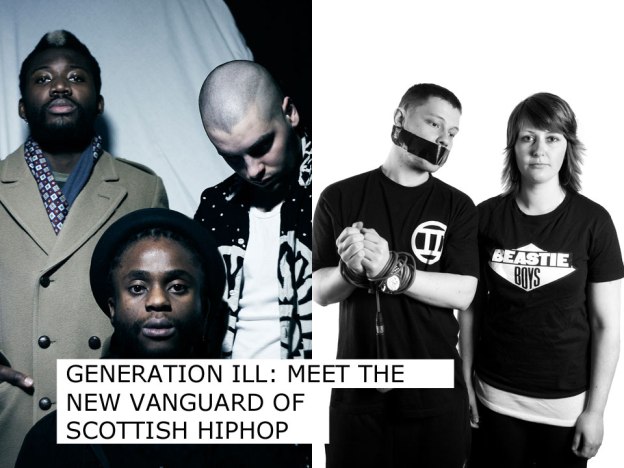
Originally published at kemptation.com on 15 September 2014. Words by Michael Gardiner
Loki got it right when he described his native Pollok as his lyrical “muse.” Situated in the southwest of Glasgow, the housing scheme’s reputation is well documented: high unemployment, gang violence, and below-average life expectancy; topics ripe for harrowing and compelling prose. “Whether you want to be poetic or political, there is lots of subject matter to wade through as a writer when you are sitting staring directly out onto Glasgow,” said the veteran rapper, journalist and community activist, arguably one of the most respected voices in Scottish underground hip hop.
Loki’s songs are a constant, captivating struggle between the bleak, weary realism of the No Mean City and rich, poignant allegories that imply hope and change. It’s a love-hate relationship with the city, something most Scottish rappers can agree on. As John Lowis, aka, Louie, frontman of Glasgow duo Hector Bizerk, explains, “Language, accent and life experience are the main sources of inspiration for hip hop anywhere in the world. Identity is more prevalent in hip hop than any other genre, so it makes sense that people are proud of where they are from.”
It’s strange then, that Scottish hip hop has struggled for years to gain the mainstream acceptance that its American counterpart has basked in. This is generally speculated to be down to accent; in the same way that Trainspotting was dubbed for Americans, the vernacular used by MCs was thought to be simply incomprehensible to audiences outside of Scotland. It was treated as a joke. People like the Burberry-wearing, Buckfast-swigging Wee Man became YouTube sensations from ripping the pish out of it.
In the last couple years, though, the story has started to change. A handful of tight-knit artists are bringing a new dawn to the scene. For Ciaran Mac, a 21-year-old MC from Cardonald, hip hop in Scotland has taken on a life of its own. “I think it’s important to use your own accent and local slang,” he says. “The days of feeling like you have to rap in a different accent are long gone.”
Indeed, Mac makes this clear on his debut self-released EP, Took Your Time, where he spits multisyllabic rhymes over lush, atmospheric beats reminiscent of 90s jazz rap. The effect is jarring yet brilliant – boom bap torn from its NY roots and replanted on a Glasgow council estate. ‘Cat’ becomes ‘C***’, ‘Whack’ becomes ‘Pish’, the popo; the ‘screw crew’, the gat; the knife. “People are more open to listening to hip hop in their own vernacular nowadays,” he continues. “Scottish hip hop is more popular than ever at the moment.” In regards to using the C word: “that’s just a Glaswegian/Scottish thing, and in hip hop wherever you’re from people will use words and phrases that are just regular to them which might get misinterpreted by listeners from different cities and countries.”
Mac fell into the hip hop scene “by accident.” He’s been writing rhymes since he was very young but only began to perform live when he was 18 after meeting Mark McGee of Glasgow band The Girobabies. “I kind of got pushed into this scene as a really under-confident, stage shy MC who never wanted to be the centre of attention or anything like that,” he explains. “I got talked into rapping in front of Mark and he was impressed. From there, he dragged me up on stage to perform impromptu with his band a couple of times and I found myself then pushed into the Scottish hip hop scene.”
And what a diverse and colourful scene it is. No wonder, given that it’s practically compulsory for any self-respecting new band to pull together dizzyingly idiosyncratic sounds. Take the ballistic tribal chants of Young Fathers, who recently won Scottish Album of the Year for their Anticon sophomore Tape Two, or the synthetic satire of Stanley Odd (last year’s nominees). Or perhaps you’d prefer another Auld Reekie street poet, Madhat McGore, the schizoid mash-ups of Dundee’s Theholyc, the neon synth hooks of Aberdeen’s SHY & DRS, or the murky sampledelica of Inverness’s Paul Scotti. Then there are old hands like MOG, Gasp, Mistah Bohze and, of course, Loki, who will be taking his new project, Government Issue Music Protest (GIMP), around the country this month.
With platforms like Soundcloud and Bandcamp, the millenials who comprise the majority of the Scottish hip hop scene have the opportunity to share and distribute their work worldwide. For good or ill, this techno maelstrom has ushered in a new age of DIY ethics, of being able to succeed on one’s own terms. Of course, the genre has always been about support, too. “There are so many other ways that Scottish media could help our scene grow,” says Jay McLeary, co-owner of Edinburgh record label Music Comes First, home to Madhat McGore among others. “I think until the fan base of Scottish artists is at a point where the media can no longer ignore the artist, many artists will need to continue that struggle to get maximum exposure.”
Ciaran Mac also believes that the scene deserves more media attention. “Most people I come across, who listen to Scottish hip hop, really love it; it’s got that kind of Marmite effect,” he says. “So if there was more attention, then hopefully it would create more big fans of it which would only be positive. It’s good to know, however, that Scottish music journos and bloggers are starting to accept it as something serious.”
But why now? “Maybe with the current political climate, people are more open to hearing hip hop in their own vernacular,” says Hector Bizerk’s Louie. “If the general public are more open to the idea of discussing local, regional, and national matters in everyday conversation, then hip hop culture is the perfect fit for them as guys like myself, Loki, Gasp, Mistah Bohze have been discussing for years through song.”
Louie, along with drummer Audrey Tait, formed Hector Bizerk back in 2011. In the three years of their existence, they’ve supported the likes of MF Doom, GZA, and The Libertines, and have performed in New York to critical acclaim. With their second album, Nobody Seen Nothing, making the shortlist for Scottish Album of the Year, the duo’s lean, stripped-down take on hip hop is getting heads turning everywhere. “When we were in New York earlier this year the reaction was incredible,” says Louie. “We recently played a festival in Ireland, too, and the tent absolutely erupted a couple of songs into our set. It’s hands down the best response we’ve had away from Scotland. A girl took her knickers off and threw them at me after three songs. At the end she came up and asked me for them back!”
The duo has even been championed by hip hop pioneer Grandmaster Flash. Louie fondly recalls meeting the legend for the first time: “We played with him in Glasgow and the show wasn’t very busy. He stood and watched us and came into the dressing room afterwards and said he really liked the set. He asked if we had any albums and Audrey handed it [Drums. Rap. Yes] to him and said, “That’ll be a tenner!” He laughed, and Audrey told him to get his hands in his pocket. He did. So he bought our album.”
Although stateside rap casts a long shadow over music UK-wide, most artists working in the Scottish scene will look to their peers first for inspiration. “It’s good to talk about things that are familiar to local listeners,” says Ciaran Mac, who cites Penilee rapper, MOG, as an influence. “I like a lot of his songs where he’s talking about things I grew up doing and using patter only really familiar to my area.” MOG’s songs tackle current social issues like alcoholism and underage sex, but are not merely a depiction of his surroundings. His lyrics serve as a caution to youngsters led astray: “Stay off the corners, son; enjoy your life before it’s done,” he urges on the track Grafter. For those trapped in the chasm of urban deprivation, hip hop represents the possibility of escape, a means of expression that no other musical form can justify. It’s unsurprising that so many Scottish kids talk of how hip hop “saved them.”
The genre has always been evocatively responsive to the events of its time as well. It came of age during the country’s Thatcher-induced economic blight, and it is believed that the first Scottish hip hop record on vinyl was an anti-poll tax anthem: Demonstrate The Mass by Edinburgh’s Sugar Bullet, released in 1990 (remember, The Iron Lady introduced the policy in Scotland a year before England and Wales). Now it’s a different generation, with a new set of problems, living under a Westminster government that’s hell-bent on finishing what she started. “Your style’s dead like Maggie Thatcherism,” raps Ciaran Mac – or is it?
This new breed of twenty-somethings recognise that hip hop can be a crucible for exchanging social and political ideals, gleaned as much from experience on the scheme as a headline in The Herald. Everything, from Tory cuts to the bedroom tax, from MP pay rises to voter apathy, is fair game. They’re realists and futurists, always thinking about tomorrow. And when discussing our tomorrows, the question of Scottish independence is unavoidable. Indeed, members of the scene are not shy when it comes to voicing their political sentiments. “I am completely behind independence for Scotland,” says Jay McLeary. “It is something several of us in the Music Comes First camp feel strongly about.” He does not, however, believe independence will have an impact on music and culture: “People from Scotland are not all of a sudden going to just listen to Scottish music because independence is granted. So the same struggles of receiving attention from England, Wales and Ireland will continue.” Mac is also a passionate ‘Yes’ man: “Since the birth of hip hop, there’s always been artists speaking out about oppression and such, so it’s no surprise that the majority of the Scottish hip hop scene are behind an independent Scotland in hope of a fairer society in future.” When asked about his feelings on the matter, Louie simply replies: “Confident.”
Regardless of the outcome on Thursday 18th September, hip hop will continue to flourish in Scotland and beyond, as some of its brightest acts have already proven. McLeary reflects on the scene’s growth: “In 2009, when MCFR started, although there was a certain scene it was very closed and almost everyone knew everyone. Now, however, there are so many different branches forming that it makes it difficult to keep up to speed with everyone.”
But there is an undeniable shared aesthetic here, an abundance of artists who are representing Scottish national, ethnic and cultural identity. Once regarded as a derivative phenomenon of stateside hip hop, it is now recognisable through its own distinct expression – raw, cutting and memorable rhymes gloriously liberated from the homogeny of the English language.
 Kemptation